Tailgating causes thousands of crashes every year because drivers leave almost no room to react. Most rear end collisions happen simply because the gap between vehicles disappears too fast.
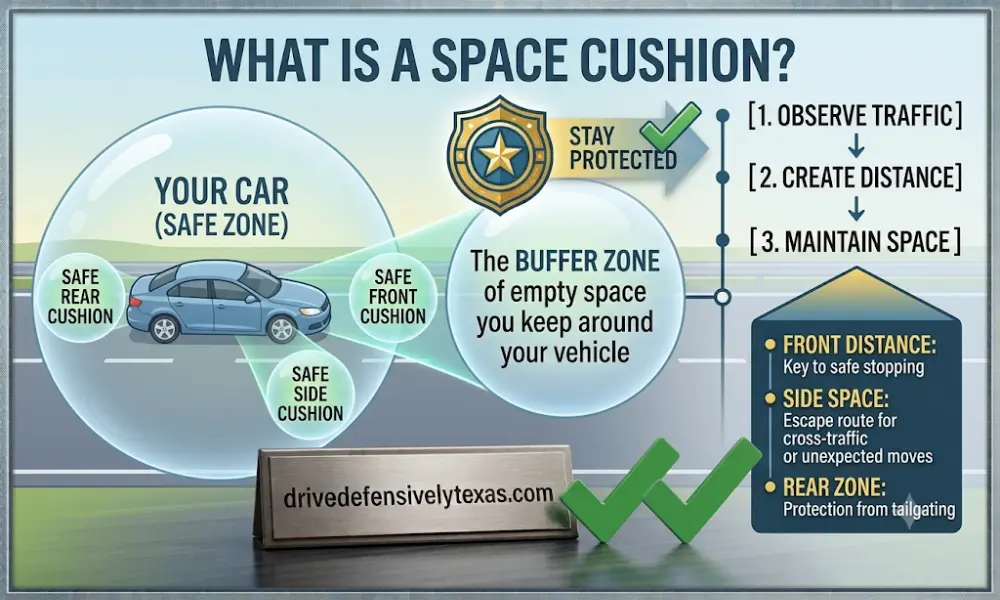
A space cushion is the safe buffer of open road a driver keeps around the vehicle. This simple defensive driving habit creates extra following distance and buys precious reaction time.
NHTSA data links nearly 29 percent of all crashes to drivers following too closely without one. So, what does it actually take to build that habit before the next long drive?
Why a Space Cushion Reduces Crash Risk
Speed completely changes stopping distance, and a tight gap leaves zero room for error. A wider space cushion works almost like insurance, since it buys reaction time instead of money.
Drivers with extra room can ease off the gas rather than slamming the brakes suddenly. Better visibility comes free with the extra gap, since brake lights become visible sooner.
Distracted driving remains a leading cause of crashes, and a solid cushion absorbs that mistake.
This collision avoidance margin becomes even more important at highway speeds with heavier traffic. A roomy cushion also reduces stress, since sudden braking rarely feels necessary anymore.
Three Zones of a Space Cushion
Driving instructors usually split the space cushion into three separate zones for clarity. The front zone covers the gap ahead that determines how safely a driver can brake. The rear zone depends mostly on how closely another driver chooses to follow behind.
The side zone protects against blind spot surprises whenever a lane change happens quickly. Good lane change safety depends heavily on a side cushion wide enough to see clearly.
Widening the front gap usually solves tailgating problems better than hard braking ever does. Building awareness of all three zones turns ordinary driving into true defensive driving practice.
How to Calculate a Safe Following Distance
The three second rule gives every driver a simple way to judge following distance. Pick a fixed object ahead, like a sign, then count seconds until reaching that spot.
Three seconds usually signals a safe space cushion during normal conditions on dry roads. Rain, fog, or higher highway speeds call for doubling that count to four or five seconds.
Mastering this judgment takes real practice, not just reading about it once and forgetting. Many drivers build this skill faster through an Online Defensive Driving Course San Antonio with guided lessons.
Mistakes That Shrink a Driver’s Space Cushion
Tailgating remains the most obvious mistake, yet subtler habits shrink the cushion too. Following a large truck too closely blocks the view ahead and steals reaction time. Squeezing into a narrow gap during a lane change often kills the side cushion.
Bad weather tempts drivers to keep the same gap instead of adding extra room. Phone use behind the wheel quietly steals attention long before the bumper gets close.
Rolling through a yellow light without slowing also quietly erodes the front cushion. That lapse rarely feels dangerous until the moment it actually becomes one.
How Following Too Closely Can Affect a Driving Record
A following too closely citation costs more than just a fine at the scene. That violation often lands on official driving history and can raise insurance rates for years.
Insurance companies often review that record closely before adjusting premiums at renewal time. Texas drivers facing a citation, job application, or insurance review sometimes need verified history.
Anyone needing proof can Get Your Texas Type 3A Driving Record through an official request process. Keeping a steady space cushion habit protects both safety and a clean record.
Building the Space Cushion Habit for Every Drive
Small adjustments slowly turn this idea into a reflex instead of a rule. Scanning twelve to fifteen seconds ahead helps spot trouble before it reaches the bumper. Checking mirrors every few seconds keeps both rear and side zones constantly updated.
Slowing down before a curve, intersection, or merge point preserves the cushion automatically. Practicing this defensive driving mindset daily eventually makes the habit feel completely automatic.
Patience behind the wheel pays off far more than rushing through heavy traffic ever does. Consistency matters far more than perfection, since the habit compounds over thousands of miles.