A second traffic ticket within months of the first leaves most drivers stuck, unsure whether another defensive driving course will even help this time. Can I Take Defensive Driving Twice?
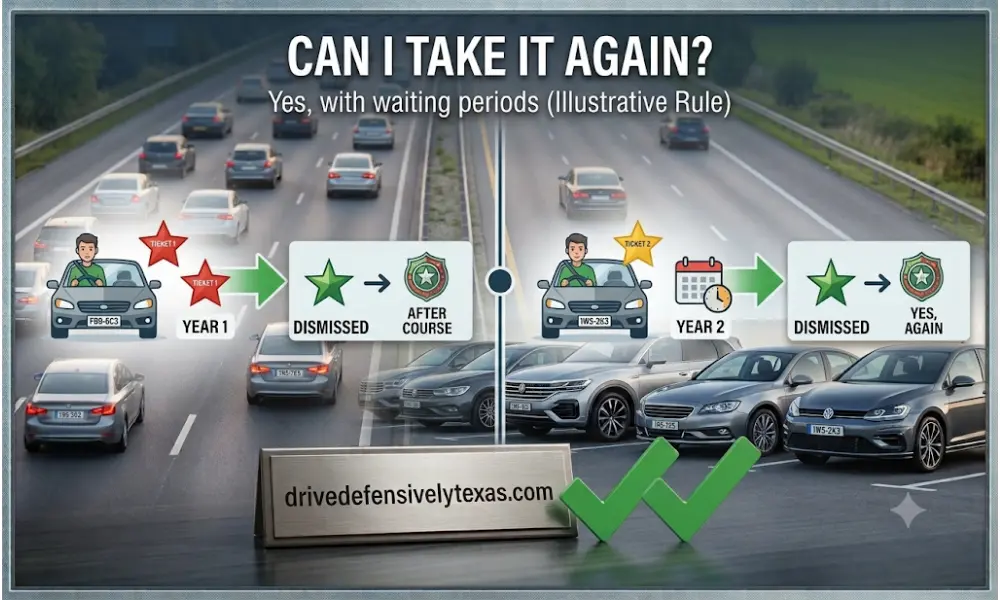
Yes, but only once every 12 months counts for ticket dismissal in Texas. That single rule trips up thousands of drivers every year, since courts check the completion date from the last class before approving a new one.
Texas courts process roughly a million dismissals annually through these courses, which shows just how reliable this option is when the timing actually lines up.
Knowing the exact rules around eligibility, exceptions, and excluded violations turns a confusing situation into a clear next step.
Can I Take Defensive Driving Twice?
The short answer is no, not for dismissal purposes within the same 12 months. Texas courts count from the completion date of the prior course, not the new ticket date.
A driver cited twice in eight months typically pays a fine or attends court for the second citation. This rule keeps the system fair, since repeat dismissals would defeat the purpose of teaching safer habits.
Checking the official driving record clears up the exact eligible date before committing to a course.
The 12-Month Rule Explained
Once a course gets reported to the Texas Department of Public Safety, that date becomes the official clock for every future request. Courts cross-check this record automatically, so an early second attempt gets flagged fast.
Local court policy can add extra restrictions on top of the state rule too. Calling the issuing court before paying for a class saves both time and frustration. Some courts dismiss only the first ticket in a cluster and require standard handling for the rest.
Exceptions to the Rule
Insurance-discount courses run on a separate track from dismissal courses entirely. Completing one for a discount never touches the once-a-year dismissal limit.
Fleet drivers and rideshare drivers sometimes retake safety training yearly as a job requirement, independent of any citation. Voluntary refreshers stay open at any time too, since Texas places no cap on personal learning.
Anyone aiming for an insurance discount should state that intent during signup, since dismissal courses and discount courses rarely overlap.
Violations That Don’t Qualify
Certain citations stay off the table no matter how much time has passed. Speeding 25 mph or more over the limit, driving without insurance, and passing a stopped school bus all fall into this category.
Hit-and-run incidents and construction zone violations get excluded too. Commercial license holders generally can’t use the course for dismissal at all. Checking eligibility before enrolling avoids finishing a course the court was never going to accept.
Confirming Eligibility First
A quick check before signing up prevents wasted money on a rejected certificate. Pulling the driving record shows the exact completion date from any prior course.
Calling the court listed on the new ticket confirms whether it accepts the course for that specific charge. Asking about judicial discretion matters too, since some judges grant exceptions in unusual situations.
An Online Texas Defensive Driving Course makes this entire process simple to handle from any device.
Picking the Right Course Format
Format matters nearly as much as timing does. Self-paced online programs suit drivers juggling unpredictable work schedules throughout the week. In-person classes still appeal to anyone wanting a fixed schedule and classroom structure.
Drivers near North Texas might look into a Driving Course in Dallas for that setup. Confirming TDLR approval beforehand guarantees the certificate gets accepted by the assigned court.
Getting the Most From a Repeat Course
Once the 12 months have genuinely passed, a second course becomes a real refresher rather than a repeat. Real-world driving experience makes lessons on following distance and hazard awareness land differently the second time.
Many drivers notice fewer near-misses afterward simply because the habits stick better with practice behind them. Calling support to verify the exact eligible date avoids miscounting by even a week. That small step keeps the whole process on track.
A second ticket doesn’t have to mean a dead end, since the right timing and the right course still make dismissal possible for plenty of drivers. Checking the completion date and calling the court takes minutes and avoids an expensive guess.
So has the 12-month clock actually run out yet, or is it worth a quick call to find out?